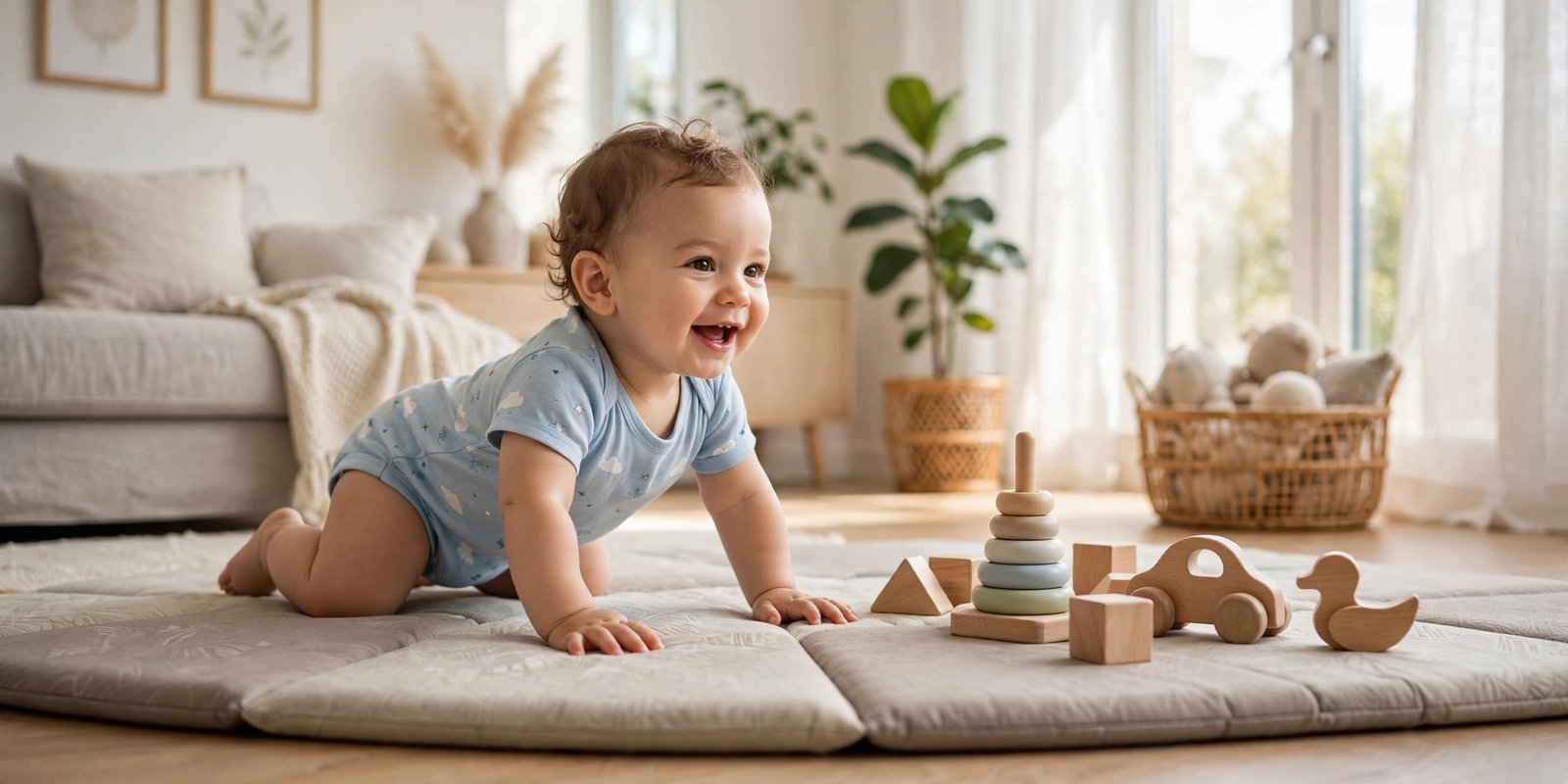
One of the most exciting milestones in your baby’s first year is the moment they start moving on their own. Crawling opens up a whole new world — suddenly your baby can explore, chase toys, and get to you all by themselves. But when exactly does it happen, and what can you do to help? Here is what to expect.
For more milestone guides and practical baby care tips, visit the Healthy Baby Guide homepage.
When Do Babies Start Crawling?
Most babies start crawling between 6 and 10 months, with the average around 8 to 9 months. Some babies skip crawling altogether and go straight to pulling up and walking — this is also perfectly normal. Every baby develops at their own pace, and a baby who crawls at 10 months is not behind a baby who crawls at 7 months.
Before true crawling, you will usually notice a sequence of mini-milestones: rolling over, sitting without support, rocking back and forth on hands and knees, and army-crawling (dragging themselves along on their tummy). Each stage builds the strength and coordination needed for the next.
Signs Your Baby Is Getting Ready to Crawl
- They push up onto their hands and knees and rock back and forth.
- They can sit steadily without toppling over.
- They reach eagerly for toys that are just out of reach.
- They pivot or scoot while lying on their tummy.
- They try to pull themselves forward, even if they slide backwards instead.
That backwards slide is very common and often funny to watch. Babies push with their arms before their legs catch up, so they end up going the wrong way. It is a good sign — it means they are figuring out how movement works.
How to Encourage Crawling
Give plenty of tummy time
Tummy time is the single most useful thing you can do. It strengthens the neck, shoulders, arms, and core muscles that crawling depends on. Aim for short, frequent sessions throughout the day rather than one long one, and always stay close by.
Create tempting goals
Place a favourite toy just beyond your baby’s reach during tummy time. A toy that lights up, makes sounds, or rolls slowly is especially motivating. Resist the urge to hand it over — a little frustration is what drives them to move.
Make the floor inviting
A firm, flat surface works best. Hard floors or a thin play mat give better grip than thick carpets or soft beds. Dress your baby in clothes that let their knees and hands grip, and skip socks on slippery floors if you can.
Show them how
Get down on the floor yourself and crawl alongside your baby. Babies learn by copying, and a parent crawling around the living room is both a lesson and a game. You can also gently guide their legs in a crawling motion while they are on their hands and knees.
Baby-Proof Before They Get Moving
Once crawling starts, your baby can reach hazards fast. Before they take off, cover electrical sockets, secure heavy furniture to the wall, fit stair gates, and move cleaning products, medicines, and small objects out of reach. Get down to floor level and look around — you will spot dangers you never noticed from standing height.
When to Talk to Your Doctor
Most crawling variation is completely normal. However, mention it to your paediatrician if your baby shows no interest in moving by 12 months, cannot bear weight on their legs, always drags one side of their body, or seems unusually stiff or floppy. These are worth checking, but in the vast majority of cases the answer is simply that your baby is developing on their own schedule.
Enjoy This Stage
Crawling is messy, exhausting, and wonderful. Your baby will bump into things, get stuck under furniture, and proudly present you with every speck of dust they find. It is also the start of real independence. Give them a safe space, lots of encouragement, and plenty of floor time — and they will get moving when they are ready.