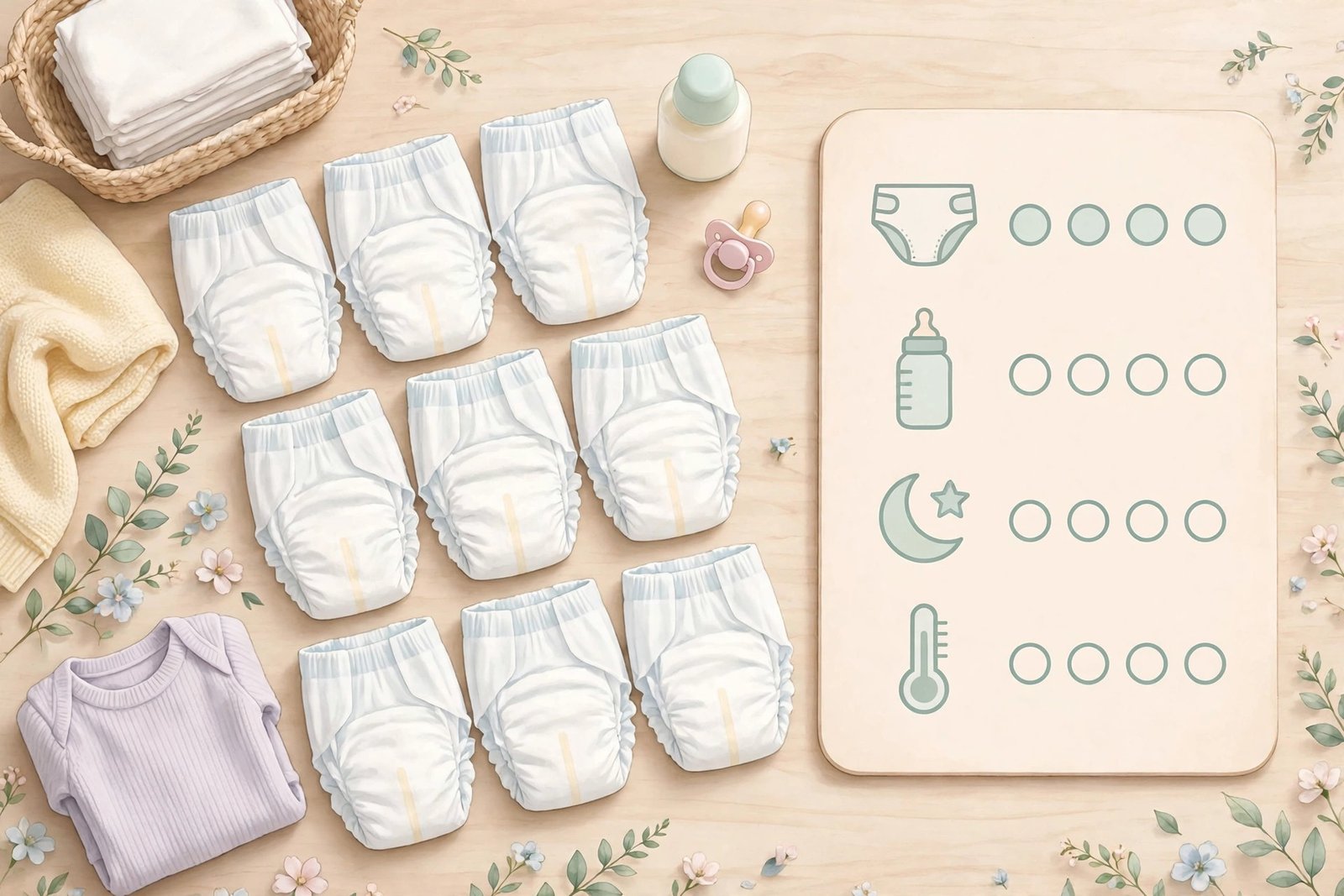
New parents count everything: feeds, naps, and yes — wet nappies. It is one of the simplest ways to check that your newborn is getting enough milk, and paediatricians ask about it at every early check-up. But the “right” number changes day by day in the first week, which confuses a lot of parents. Here is exactly how many wet diapers a newborn should have daily, by age.
Why wet nappies matter
A wet nappy is direct evidence that your baby is hydrated and feeding well. In the first days of life, when your milk is still coming in, nappy output is one of the main things doctors monitor — alongside weight — to make sure feeding is on track. Once feeding is established, it stays a useful everyday gauge of your baby’s health.
How many wet diapers should a newborn have daily? A chart by age
Use this simple guide for the first week:
- Day 1 (first 24 hours): at least 1 wet nappy
- Day 2: at least 2 wet nappies
- Day 3: at least 3 wet nappies
- Day 4: at least 4 wet nappies
- Day 5: at least 5 wet nappies
- Day 6 onwards: 6 to 8 wet nappies per 24 hours
The pattern is easy to remember: roughly one wet nappy per day of life until day six, then six to eight a day from then on. A “wet” nappy means noticeably damp — a heavy, squishy nappy with pale yellow urine. Modern disposable nappies are so absorbent that a lightly damp one can be hard to spot; look for the wetness indicator line, which turns colour when wet.
What counts as a wet nappy?
Parents sometimes wonder whether a barely-damp nappy counts. A good test: hold a clean, dry nappy in one hand and the used one in the other. If the used one is clearly heavier, it counts. Pale, almost colourless urine is a sign of good hydration. Dark yellow or orange urine — or pinkish “brick dust” crystals in the first few days — is worth mentioning to your midwife or doctor.
Wet nappies and feeding: what they tell you
Breastfed babies
In the first two to three days, before your milk comes in, small frequent feeds of colostrum produce fewer wet nappies — and that is expected. Once your milk arrives (usually day 3-5), output should climb quickly to six or more wet nappies a day. If it does not, talk to your midwife or lactation consultant promptly.
Formula-fed babies
Formula-fed newborns typically reach six to eight wet nappies a day a little earlier, since intake is more measurable from the start. The same minimums apply — and the same warning signs if output drops.
Dirty nappies: the other half of the picture
Wet nappies get the attention, but stools matter too. In the first week, expect:
- Days 1-2: thick, black, tarry meconium
- Days 3-4: greenish-brown transitional stools
- Day 5 onwards: yellow, seedy stools (breastfed) — at least 3-4 a day in the early weeks
After the first month, breastfed babies may go several days without a stool and still be perfectly fine, as long as wet nappies stay at six or more a day and the baby is comfortable.
Warning signs: when to call your doctor
Contact your paediatrician or midwife promptly if you notice:
- Fewer wet nappies than the day-of-life minimum in the first week
- A sudden drop in wet nappies after feeding was well established
- No wet nappy for 6-8 hours in an older newborn
- Dark yellow urine, strong-smelling urine, or blood in the nappy
- A sunken soft spot (fontanelle), dry mouth, or unusual sleepiness alongside low output
- Fever in a newborn under 3 months — always seek care the same day
Trust your instincts: if something feels off, a quick call costs nothing.
Practical tips for tracking
- Use a simple log: a notes app or a scrap of paper by the changing table is enough for the first two weeks.
- Change nappies often: every 2-3 hours during the day keeps the skin healthy and makes counting easy.
- Check the indicator: most disposable nappies have a wetness line — learn what yours looks like when wet.
- Do not stress over one quiet day: a single slightly-low day with an otherwise happy, alert baby is rarely a problem. A pattern over two days is what matters.
The bottom line
How many wet diapers should a newborn have daily? At least one per day of life for the first five days, then six to eight a day from day six onwards. It is one of the simplest health checks you can do at home — no gadgets, just a glance at the nappy. For more straightforward newborn care guides, visit Healthy Baby Guide — practical answers for the questions that keep new parents up at night.