If your baby wakes at the first hint of morning light, the problem may not be their sleep routine at all — it may be the window. Blackout blinds are one of the simplest, most effective tools for better nursery sleep, and choosing the right pair can make a real difference to how long your little one naps and how early they wake.
Good blackout blinds block almost all outside light, helping your baby’s body clock settle into a steady rhythm. Here is what to look for, and which types work best in a nursery.
Why Blackout Blinds Help Babies Sleep Better
Babies are very sensitive to light. Even a small amount of daylight creeping around the edges of a curtain can signal to their brain that it is time to wake up. This is especially true in summer, when the sun rises as early as 5am, and during daytime naps when the room never gets properly dark.
A dark room supports the natural production of melatonin, the hormone that helps us fall asleep and stay asleep. Paediatric sleep experts often recommend a room that is dark enough that you can barely see your hand in front of your face. Blackout blinds are the easiest way to achieve that, and they also help keep the room cooler on hot days.
What to Look for in Nursery Blackout Blinds
True blackout fabric
Not all blinds labelled “blackout” block the same amount of light. Look for blinds with a coated or multi-layer fabric, and check the product description for a light-blocking rating. The best nursery blinds block 99 to 100 percent of light when closed.
Safe cords — or no cords at all
This is the most important safety point. Loose cords and loops are a strangulation hazard for babies and toddlers. Choose cordless blinds, a motorised option, or blinds with a fixed tensioner that keeps the cord taut against the wall. In the UK, corded blinds must meet safety standards, but cordless is always the safest choice for a nursery. For more nursery safety guidance, see our guides on the Healthy Baby Guide homepage.
A good fit with minimal light gaps
Light leaks in around the edges, so measure carefully. Blinds fitted inside the window recess look neat, but blinds fitted outside the recess — overlapping the frame by a few centimetres on each side — block more light. Some parents add a blackout liner or a portable blackout sheet behind the blind for a near-total seal.
Easy cleaning
Nurseries get dusty, and blinds collect it. Choose a wipe-clean fabric or a style you can dust easily. Avoid heavy fabrics that trap dust and are hard to wash.
Best Types of Blackout Blinds for a Nursery
Roller blackout blinds
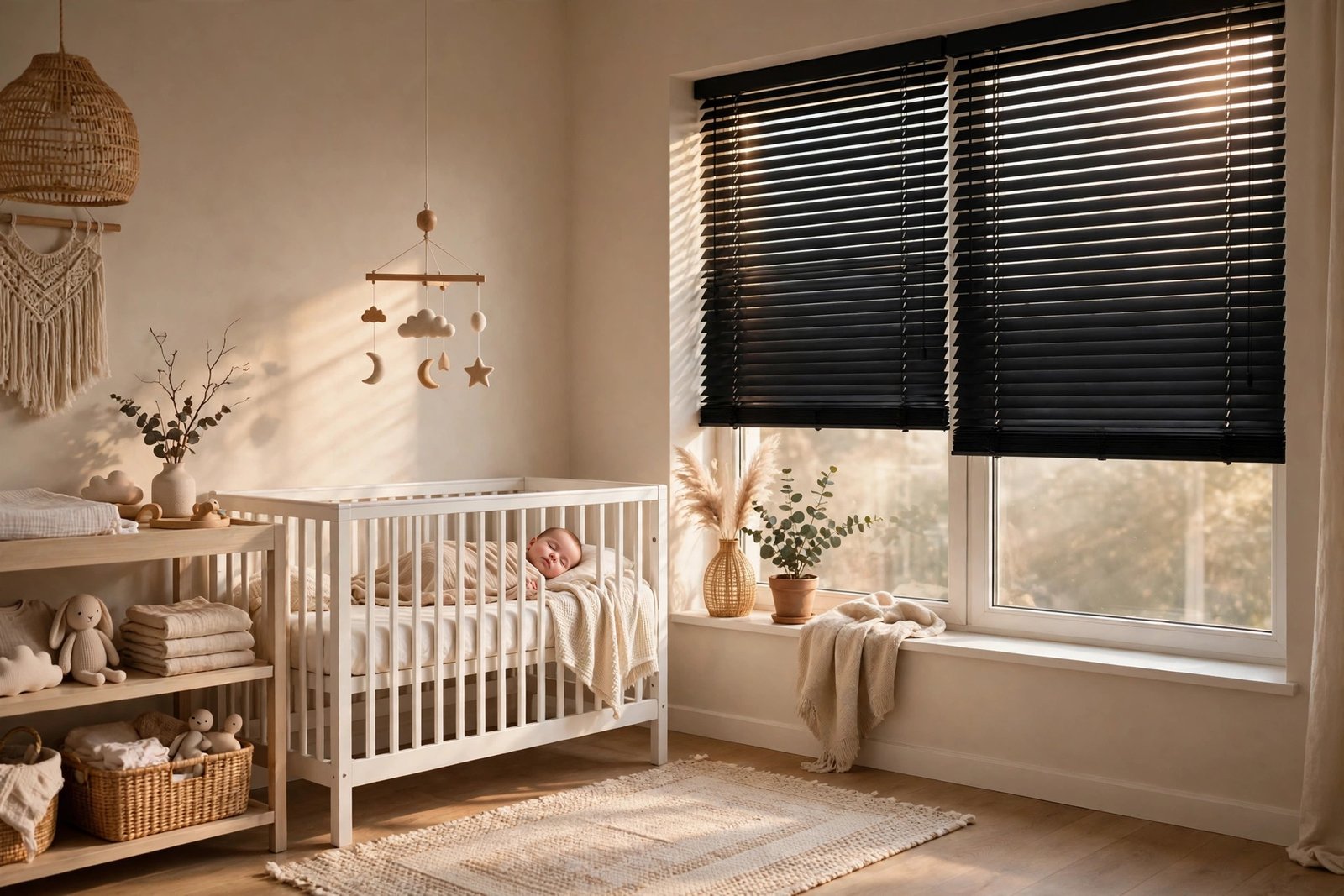
Roller blinds are the most popular choice for nurseries, and for good reason. They are simple, affordable, and available in cordless and motorised versions. A good quality roller blind with blackout fabric gives excellent light control, and you can roll it up fully during the day to let in natural light. Look for one with a side channel or a cassette at the top to reduce light gaps.
Roman blackout blinds
Roman blinds look softer and more decorative, which suits many nurseries. They fold up in neat pleats and come in a wide range of fabrics and colours. Make sure the one you choose has a proper blackout lining rather than just a thick fabric, and check that the cord mechanism is child-safe or cordless.
Cellular (honeycomb) blackout blinds
Cellular blinds have a honeycomb structure that traps air, so they insulate as well as block light. This can help keep the nursery at a comfortable temperature through the night. They are a good option if the nursery window faces the sun or gets cold in winter.
Portable blackout blinds
If you travel often, or rent your home and cannot fit permanent blinds, a portable blackout blind is worth having. These use suction cups or a static-cling backing to stick to the window, and they fold away into a small bag. They are not as neat as a fitted blind, but they are very useful for holidays and visits to grandparents.
How to Fit and Use Them for the Best Results
- Measure twice. Measure the width and drop of the window in three places and use the smallest measurement for an inside fit, or add 5 to 10 centimetres each side for an outside fit.
- Close them 30 minutes before bedtime. This lets the room cool and darken while you do the bedtime routine, so your baby associates the dark room with sleep.
- Keep the room dark for naps too. Consistent darkness helps your baby learn that dark means sleep, day or night.
- Pair them with a white noise machine. Darkness handles the light; gentle background sound handles street noise.
- Check the fit after fitting. Sit in the room with the lights off and look for light leaking around the edges. A small gap at the sides is normal, but a large gap means the blind is too narrow.
The Bottom Line
The best blackout blinds for a baby nursery are cordless, well-fitted, and made from true blackout fabric. A simple cordless roller blind is the safest and most practical choice for most families, while cellular blinds add insulation and Roman blinds add style. Whichever type you choose, a dark, cool, quiet nursery is one of the best gifts you can give your baby’s sleep — and your own.