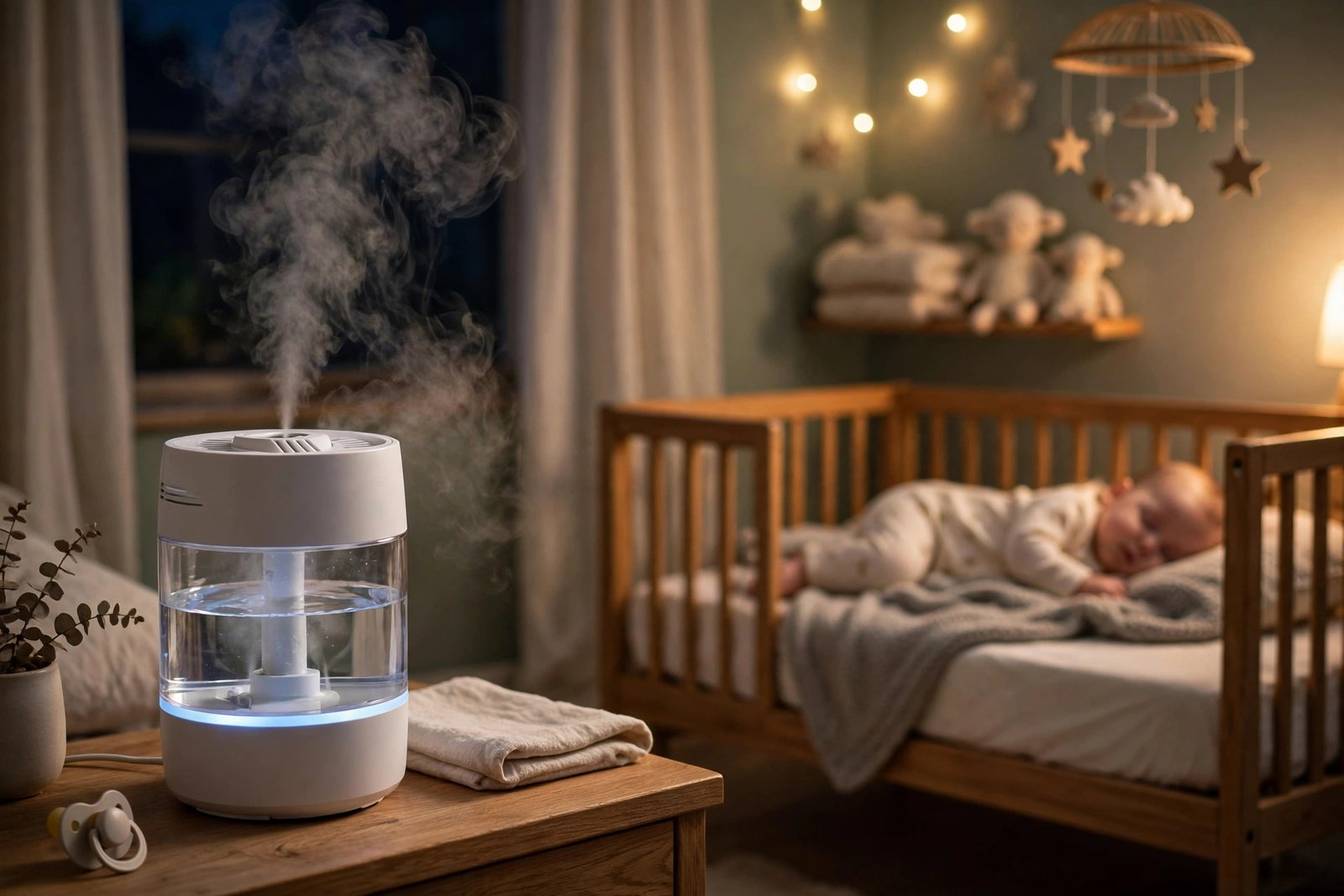
When your baby has a cough or a cold, the air in the nursery matters more than most parents realise. Dry indoor air can irritate a stuffy nose and make coughing worse at night, while properly humidified air helps loosen mucus and lets your baby breathe and sleep more comfortably. A good nursery humidifier is a simple, affordable way to help — but only if you choose the right type and use it safely.
Why a Humidifier Helps a Baby With a Cold
Colds cause swelling inside the nose, and dry air dries out that delicate lining further. A humidifier adds moisture to the air, which keeps nasal passages moist, thins mucus, and can ease the coughing that often gets worse at night. Many parents notice their baby sleeps in longer stretches once the room humidity is in the healthy range of 40 to 60 percent.
It will not cure the cold — only time does that — but it can make the nights much easier for everyone.
Cool Mist vs Warm Mist: Which Is Safer for a Baby?
For a baby’s nursery, cool mist is the safer choice. Warm-mist humidifiers boil water, which creates a burn risk if a curious toddler tips the unit over, and they also use more electricity. Cool-mist ultrasonic or evaporative models add moisture without heat, so they are the standard recommendation for children’s rooms.
Within cool-mist models, ultrasonic humidifiers are quieter — an advantage in a nursery — while evaporative models are slightly less likely to over-humidify a room. Either type works well; quiet operation is usually the deciding factor.
What to Look for When Buying
- Easy cleaning. This is the most important feature. A humidifier that is hard to clean will grow mould and bacteria. Choose a wide opening and few hard-to-reach parts.
- Right tank size. For a typical nursery, a 2 to 4 litre tank running overnight is enough. Bigger tanks mean fewer refills but a heavier unit.
- Built-in humidistat or auto shut-off. The unit should stop when the room reaches the target humidity, and shut off automatically when the tank runs dry.
- Quiet operation. Check the noise level — under 30 decibels is ideal for a sleeping baby.
- No added fragrance or essential oils. Do not add oils or vapour rubs to a baby’s humidifier unless your doctor advises it.
How to Use a Nursery Humidifier Safely
A humidifier only helps when it is used correctly. Keep these rules in mind:
- Place it on a flat, stable surface at least a metre from the cot, out of your baby’s reach.
- Use clean tap water or distilled water, and change the water daily — never top up old water.
- Clean the tank and parts every two to three days following the maker’s instructions, to stop mould and bacteria building up.
- Keep the room between 40 and 60 percent humidity. Too much moisture can encourage mould and dust mites, so a cheap room hygrometer is worth having.
- Run it mainly at night and during naps, rather than all day.
Common Mistakes to Avoid
The biggest mistake is letting a humidifier run for weeks without cleaning — that can make the air worse, not better. The second is placing it too close to the cot, which can dampen bedding. And if your baby’s cough comes with a high fever, fast breathing or trouble feeding, see your doctor rather than relying on the humidifier alone.
Do You Need One if Your Baby Is Healthy?
In a normally humid home, probably not. A humidifier earns its place in winter, in centrally heated homes, or in dry climates where indoor air gets very dry. If your baby regularly wakes coughing in winter, it is well worth trying.
For more everyday baby health and nursery advice, browse our guides on the Healthy Baby Guide homepage.
The Bottom Line
The best baby humidifier for coughs and colds is a quiet, easy-to-clean cool-mist model with auto shut-off — used with fresh water, cleaned often, and kept at a sensible distance from the cot. Used that way, it is one of the simplest things you can do to help your baby breathe easier through a cold.