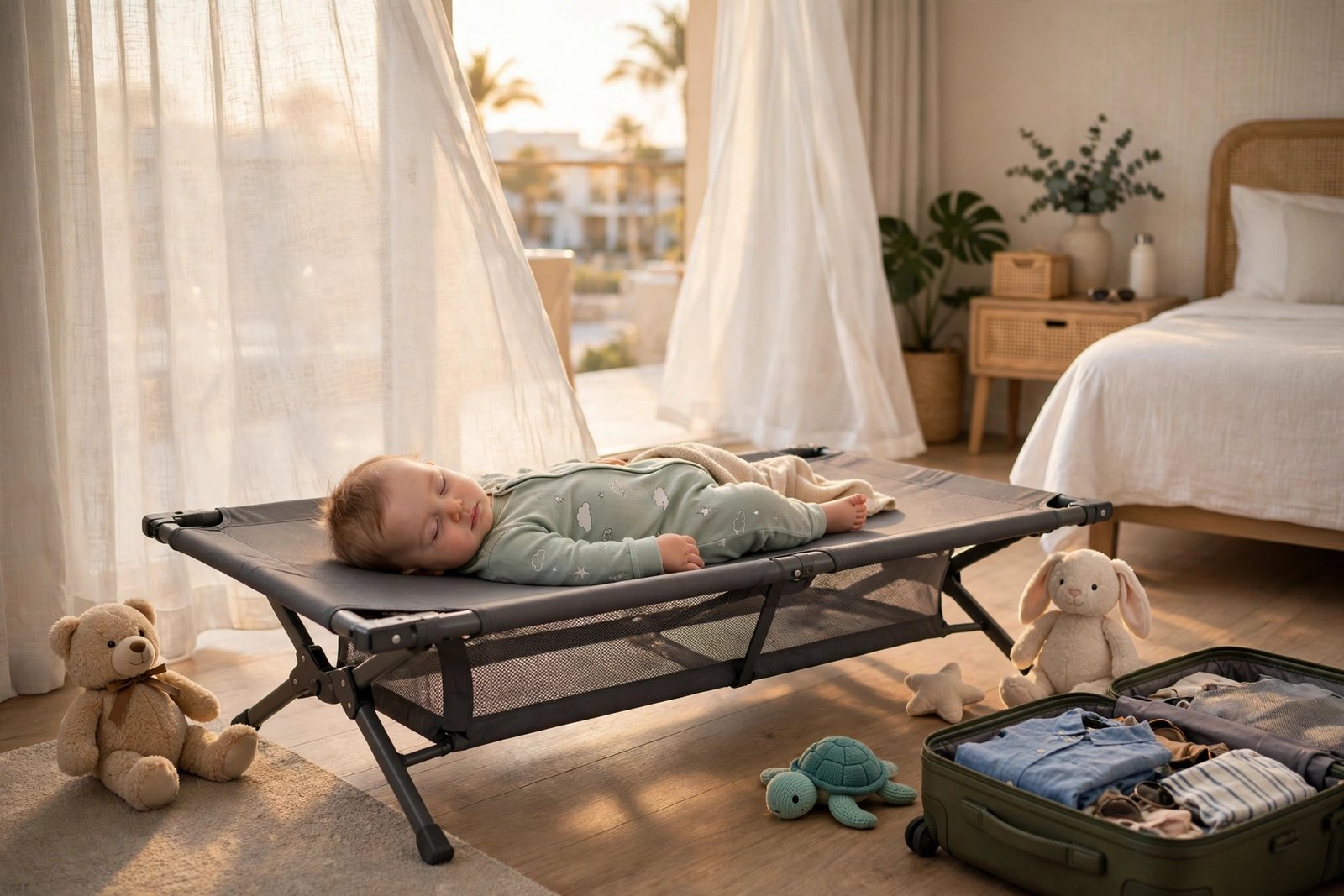
A family holiday should be relaxing, but for parents of a baby, one worry often comes first: will they actually sleep? At home, your baby has their own cot, their own room, and a routine that works. On holiday, all of that changes. A travel cot in a strange room can feel very different to a little one, and a few unsettled nights can leave the whole family exhausted. The good news is that with a little preparation, you can help your baby sleep in a travel cot on holiday almost as well as they do at home.
Start Practising Before You Go
Do not wait until the first night of your holiday to introduce the travel cot. Set it up at home a week or two before you travel and let your baby nap in it a few times. This gives them a chance to get used to the feel, the smell, and the size of it, so it is not completely new on the night that matters. If your baby sleeps in it happily at home, they are far more likely to settle in it away from home.
Use the same sheets and sleeping bag in the travel cot that your baby uses at home. Familiar smells are surprisingly powerful for babies, and a sheet that smells like home can make a strange room feel much safer.
Choose the Right Travel Cot
Not all travel cots are the same, and the right one makes a real difference. Look for a cot with a firm, flat mattress that fits snugly with no gaps around the edges. A soft or saggy mattress is not safe for a baby to sleep on. The cot should be sturdy, with no loose parts, and easy to set up and fold down, because you will be doing it when you are tired.
Some travel cots come with a raised bassinet level for younger babies, which saves your back during night feeds. Others are very light and pack into a small bag, which is ideal if you are flying. Whatever you choose, check that it meets current safety standards and that the mattress is the one designed for that cot, not a random replacement.
Recreate the Home Routine
Babies thrive on routine, and holidays are the worst time to abandon it. Keep your baby’s bedtime routine as close to normal as you can: bath or wash, pyjamas, a story or a song, and then into the cot. Even if the timings shift a little, the familiar steps tell your baby that sleep is coming.
Take the small things that signal bedtime at home. Their favourite comforter or soft toy, their usual sleeping bag, and even a white noise app on your phone can all help bridge the gap between home and holiday.
Make the Sleep Space Dark and Calm
Hotel rooms and holiday cottages are rarely as dark as a baby’s bedroom at home. Thin curtains, street lights, and early morning sun can all wake a baby far too early. Pack a portable blackout blind, or use a large dark towel or a travel blackout sheet over the window. A dark room helps your baby fall asleep and stay asleep, just like at home.
Keep the room cool too, ideally between 16 and 20°C, and dress your baby in light layers so they do not overheat. If you are sharing the room, try to keep your own lights and noise low once your baby is asleep, and resist the urge to check on them every few minutes.
Where to Put the Travel Cot
If you can, place the travel cot in the quietest corner of the room, away from the door and away from direct light. Some families use a separate room or a walk-in wardrobe as a makeshift nursery, which gives everyone a better night. If you are sharing one room, a simple room divider or even a hung sheet can create a little sense of separation that helps your baby settle.
Never be tempted to use a travel cot with the sides down, or to add extra padding, pillows, or loose blankets. A baby should always sleep on their back, on a firm flat surface, with nothing loose in the cot.
Handling Night Wakes on Holiday
Even with the best preparation, your baby may wake more often on holiday. New sounds, new smells, and a different room can all disturb their sleep. Try to respond calmly and consistently, in the same way you would at home. A gentle shush, a hand on their chest, and a few quiet words are often enough. Avoid turning on bright lights or starting a play session in the middle of the night, tempting as it may be.
Remember that a few unsettled nights are normal and do not mean you have done anything wrong. Most babies settle into the new routine within two or three nights.
Packing Checklist for Baby Sleep on Holiday
- Travel cot with its proper fitted mattress and sheets
- Your baby’s usual sleeping bag and comforter
- Portable blackout blind or travel blackout sheet
- White noise app or small white noise machine
- A familiar bedtime book or two
- Night light, so you can check on your baby without waking them
- Spare sheets and pyjamas, just in case
Our Verdict
Helping your baby sleep in a travel cot on holiday comes down to three things: practise at home first, keep the bedtime routine familiar, and make the room dark, cool, and calm. A little preparation goes a long way, and most babies adapt faster than their parents expect. With the right travel cot and a bit of patience, you can enjoy your holiday and still get a decent night’s sleep. For more practical tips on baby sleep, travel, and everyday parenting, visit Healthy Baby Guide.